
Are new North Sea projects compatible with net zero?
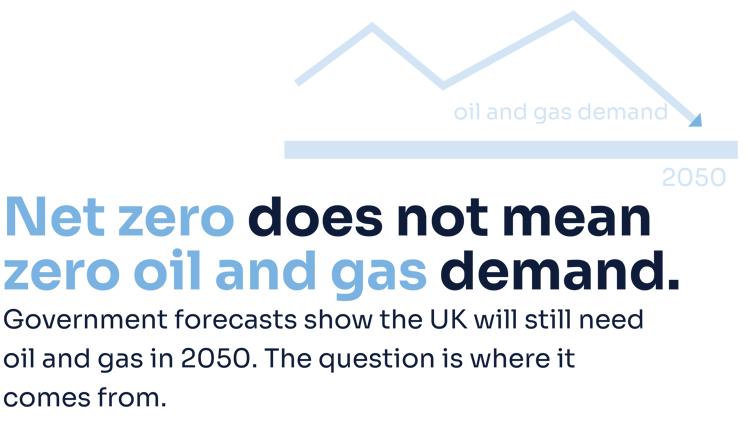
Under the Government’s own forecasts, the UK will still need oil and gas at net zero. It is only sensible this is met wherever possible by North Sea production.
The Climate Change Committee’s (CCC) Balanced Pathway modelling estimates oil will decrease by 84% and gas by 77% by 2050. This means around 16% of current oil demand and 23% of gas demand would remain, reflecting these fuels will still be needed after the UK meets its net zero targets.
The CCC forecasts the UK will require 13-15 billion barrels of oil and gas equivalent in the period 2025 to 2050. If this is not produced in the UK, it will need to be imported from countries like Norway, Qatar and the United States. The main emissions risk is greater reliance on LNG, which has significantly higher production and supply-chain emissions before it reaches the UK.
In 2022, the UK Government concluded that cutting domestic production would not lower global emissions.
With the right policies in place, however, a significant share of UK oil and gas demand between now and 2050 can be met through North Sea production.
The North Sea Transition Authority estimates that the UK Continental Shelf contains around 2.9 billion barrels of oil equivalent in proven and probable reserves, along with a further 6.2 billion barrels of discovered but still undeveloped resources. Beyond this, it identifies additional potential resources, including approximately 4.6 billion barrels of oil equivalent in mapped prospects and leads, and a further 11.2 billion barrels of oil equivalent in broader geological plays.